

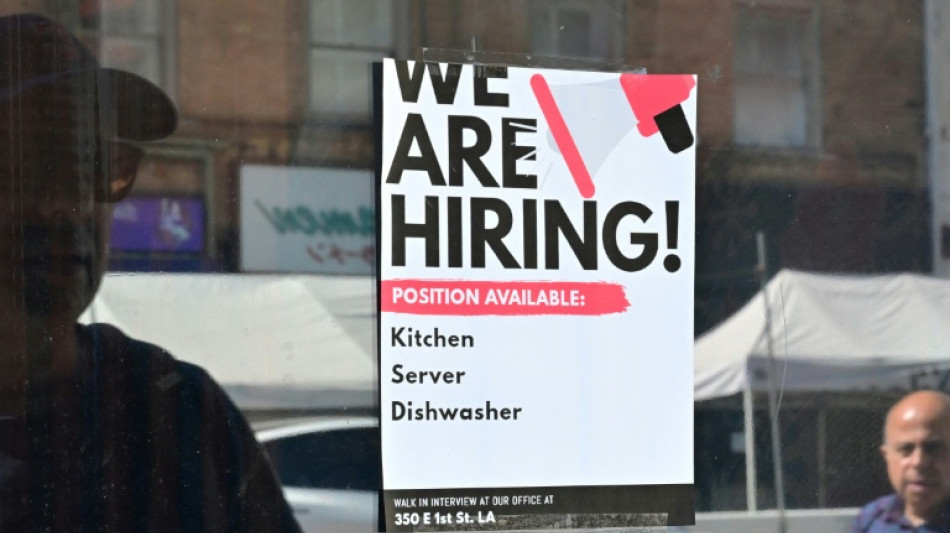
More American women holding multiple jobs as high costs sting / Photo: Frederic J. BROWN - AFP/File
Cindy Dionicio is a waitress, a saleswoman and a cleaner -- sometimes all in the same day. Like her, nearly nine million US workers hold multiple jobs, squeezed by high costs of living.
On short video platform TikTok, the 26-year-old Delaware resident's depictions of her busy days receive tens of thousands of views or more.
Twice a week, "I wake up at 3:30 am, I head to work by four at Dunkin' Donuts," she recounts.
After a three-hour shift, she drops her son off at school before occasionally picking up a sales shift at a store of luxury brand Tory Burch.
"I go to my shift at Tory Burch from 9 am to 1 pm, I come home, I pick up my son from school," Dionicio adds.
Depending on the day, she sometimes also cleans a dental office from 5 pm to 7 pm.
On top of that, she sells cleaning services for homes and vacation rentals, and is starting to receive income as a social media influencer.
She told AFP that she does not regret giving up her full-time job to juggle multiple gigs.
She makes sure that she has weekends off, goes to church on Sundays and ensures that she has family time.
"Me and my husband, we both work and we are saving money to get a house," she said, adding that they still live with her parents.
- 'Very hard' -
US government data shows the unemployment rate still relatively low at 4.4 percent as of December.
But the number of people working multiple jobs has risen. The number of women juggling two part-time jobs rose 20 percent year-on-year.
Updated figures for January will be released on Wednesday.
It is more common for women to hold several jobs, with 6.1 percent of the working population doing so. In contrast, the figure for men is 4.9 percent.
The employment market is becoming more fragile, Federal Reserve official Michelle Bowman warned in January.
"The share of those working part time for economic reasons, meaning not by choice, has increased considerably," she said.
"This has coincided with a rise in the share of multiple job holders, suggesting that an increasing number of workers struggle to make ends meet," Bowman added.
This is the case for Valeria, 59, who declined to share her last name.
She told AFP that she is unable to financially support her daughter, who is studying in Prague.
"It's very hard -- very, very hard -- because the prices of utilities, the prices of food, the health insurance, everything goes up," said Valeria, who is divorced.
At the end of the month, she added, she has barely a few hundred dollars left and "no room" for savings at all.
The art conservator's income also fluctuates depending on the assignments she receives from institutions and individuals.
She has also worked for a high-end supermarket, but said they paid poorly.
Valeria added that she cannot afford to fall ill, fearing that she could "go into foreclosure" if saddled with hospital bills that would otherwise have gone to paying her mortgage.
She does not think she will be able to retire for another 15 years.
- A choice, sometimes -
Some research shows that younger workers may prefer holding multiple part-time jobs rather than a full-time role, said Laura Ullrich, director of North America economic research at employment platform Indeed.
"With the amount of inflation we've had in recent years and the cost of housing increasing and other things, it's reasonable to think that affordability is a consideration for some families," she said.
This can push people towards taking on multiple jobs.
To Valeria, President Donald Trump's administration does not care enough about people who struggle to get by.
But she believes it was no better under Trump's predecessor, Joe Biden.
"You always feel like, where is the American dream? You know, because we are very far from the American Dream these days," she said.
(F.Dlamini--TPT)