

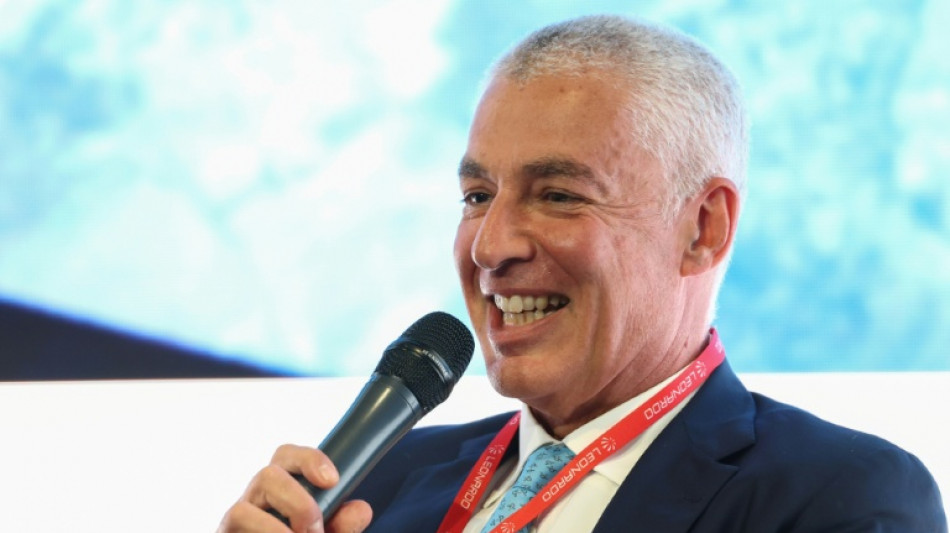
Leonardo chief sees potential for Germany to join GCAP fighter jet project / Photo: Toby Shepheard - AFP
The head of Italian defence giant Leonardo told AFP it would be "beneficial" for Germany to join an initiative led by Britain, Italy and Japan to develop a next-generation fighter jet, after its rival project with France collapsed.
The tri-national Global Combat Air Programme, launched in 2022, aims to develop a supersonic sixth-generation stealth fighter by 2035, replacing the Eurofighter Typhoon used by some European countries.
German participation in GCAP "is not an option" at the moment, but from an industrial perspective it would be "beneficial", Leonardo chief executive Lorenzo Mariani said on the sidelines of this week's Farnborough airshow, southwest of London.
Among the advantages, he cited "strong competence of the German industry, debt funding capability from the German state and joint experience within the community" on previous fighter jet projects.
"The only real risk is disruption in timescales and work share," he said.
Mariani stressed that he had not been officially approached by Germany to join GCAP, but said "informal talks among industries are always present".
France and Germany's flagship joint jet fighter project collapsed last month, after falling victim to bickering between European aviation giant Airbus and France's Dassault.
Airbus defence and space boss Michael Schoellhorn did not say whether the group would join GCAP.
He said Airbus was ready to join or build a project "where we have a significant portion of the work and the leadership".
The reshaping of alliances around the future European fighter is a key topic at Farnborough.
GCAP gained momentum this month after the three countries allocated £4.6 billion ($6.2 billion) to continue its development.
Canada on Tuesday joined the project as an "observer", paving the way for it to become a full member.
For Mariani, Canada's participation marked another step forward and could lead to "other countries wanting to achieve the same role".
- Competing with Musk -
Leonardo, along with Airbus and French defence firm Thales, meanwhile plan to merge their satellite operations to create a powerhouse to compete against Elon Musk's Starlink internet system.
The three aerospace groups are currently preparing to submit the project, called Bromo, to European antitrust regulators.
"There are a number of points that have to be studied and solved. I'm still quite optimistic that we will have the process completed in due time," Mariani told AFP.
"We have reassured the whole industrial community that Bromo will be beneficial for us, but also for customers and for the whole supply chain.
"If somebody fears that this could damage the competitiveness, I think they are wrong," he added.
The Bromo project aims to strengthen Europe's ability to compete in space, in the face of Musk's growing dominance in the market.
(D.Maluleke--TPT)