
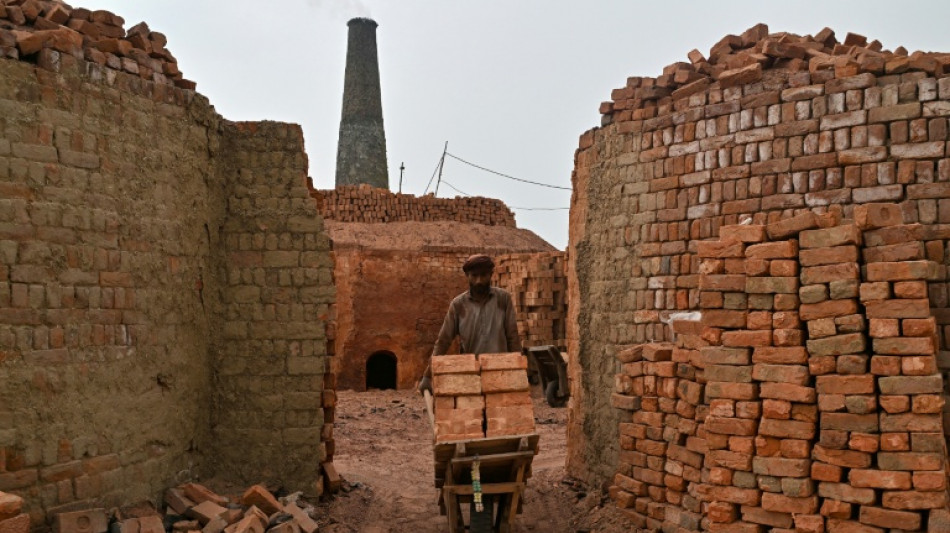
Pakistan brickmakers scorched by sun above and fire below / Photo: Arif ALI - AFP
As dark plumes billow from overhead smokestacks, brickmakers at a kiln in Pakistan's Sheikhupura district crush coal through small holes beneath their feet into the fiery chambers below.
Workers already have to endure extreme conditions at traditional brick kilns, which burn at over 1,000C and demand constant monitoring to ensure they remain hot enough.
But they are becoming almost unbearable as climate change makes summers even hotter in a country already used to temperatures well over 40C.
Abid Hussain, a 35-year-old labourer whose clothes were covered in dark soot, told AFP the work felt like being trapped between fire below and, increasingly, above.
He is one of hundreds of thousands working in an industry that labour advocates say is poorly regulated, badly paid and becoming more dangerous as temperatures rise.
"The heat is undoubtedly extreme but when you think about the financial pressures at home, you have no option but to keep working," Hussain said.
Fast-growing Pakistan's construction boom is increasing the demand for labour in the sector, in which workers earn around $3 a day.
Despite the scorching sun and dust filling the air, workers stay on the heated kiln surface for hours at a time.
"I would describe these brick kilns as places of confinement," said Syeda Ghulam Fatima, the General Secretary of the Bonded Labour Liberation Front Pakistan.
"Workers endure relentless heat from the blazing sun overhead while the intense heat radiating from the kiln rises beneath them."
The workers remain trapped in a cycle of debt, extreme heat, and deteriorating health, Fatima told AFP, adding rising global temperatures amplified the risks.
Sheikhupura is at the heart of Pakistan's massive brick kiln industry. Nationwide, more than 18,000 brick kilns employ a total of over a million people, according to 2018 data in a Climate and Clean Air Coalition report.
Pakistan is ranked among the countries most vulnerable to the impacts of climate change globally, according to experts.
Fatima said many workers receive advance payments, making them unable to decline to work in dangerous conditions without falling into burdensome debt.
Hussain, who earns roughly 25,000 Pakistani rupees ($90) a month, said the money barely covers rent and his children's basic needs.
"No matter the situation, whether we are ill or there are family matters, we still have to work," he said. "If I take time off, we'll be in trouble."
- Breaks 'not possible' -
There is some hope of improved conditions from the Punjab provincial government's push to convert the industry to more modern technology known as zigzag kilns, which reduce air pollution and respiratory hazards.
Health experts warn that, especially at traditional kilns, prolonged heat exposure makes brick workers more vulnerable to illnesses including skin disorders, respiratory problems, and kidney disease.
But "extended rest breaks are not feasible... whether it is extreme heat, cold, or rain, the work must continue uninterrupted", said Mujeeb Ullah, 45, the supervisor at the kiln, adding its temperatures needed to be kept stable.
He said they provided workers with drinking water and occasional short breaks.
On the other side of the compound, a man squatted next to rows of unbaked bricks, mixing wet mud and packing it by hand into a wooden mould -- exhausting work considering the temperatures.
Worker Muhammad Azeem, 28, said there was no alternative.
"As for the weather, whether it's good or bad, work is work, it has to be done."
(H.VanNiekerk--TPT)