

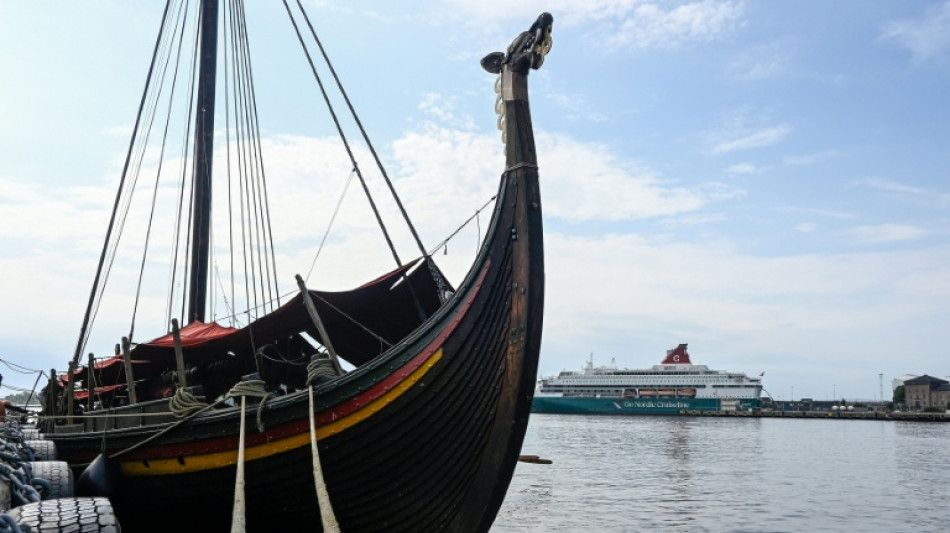
A Viking longship in 'The Odyssey'? It's a case of history meets Hollywood / Photo: Jonathan KLEIN - AFP
The eras of "The Odyssey" and the Vikings happened about 2,000 years apart -- so how did a Viking longship end up with a starring role in this year's blockbuster movie?
Look to director Christopher Nolan, and his obsession with bringing spectacle to life with real props, real scenes.
But also credit a team of Norwegian shipwrights and sailors who built a vessel that speaks to both history and Hollywood.
With its tar-soaked rigging, creaking oak deck and 50 spruce oars, Draken Harald Harfagre is the largest modern replica of a Viking ship.
It mattered little that it had to drop its Scandinavian roots for Greek mythology -- the anachronism blended into the service of Nolan's brand of realism.
For the film, though, Draken had to be stripped of the dragon figurehead at its bow -- typical of the Viking era, from the 8th to 11th centuries -- as it sailed for the cameras in Greek, Italian and Scottish waters.
"We found a Viking ship that had been built exactly according to those ancient specifications. And it was very much the whole shape and the rig that we needed to do a Bronze Age ship," Nolan told US television last month.
"We took the crew, and we put their crew all in our costumes. They became part of the movie crew, as it were. And Odysseus' guys, the actors, joined in with them, and they figured out how to raise the sail, how to rig it, how to row, all of this stuff."
For months, the longship's crew of seasoned sailors rubbed shoulders with Hollywood star Matt Damon, who plays Odysseus on-screen, and a host of professional actors.
- 'Doing the real thing' -
"There was one day where one of the actors who was sitting in front of me got seasick and threw up over the rail. It blew back on me," recalled sailor Trammell Hudson.
"I thought that would be my big scene, because the IMAX camera was very focused on him and me in the background dodging the debris. But I didn't see that particular scene in the film," he told AFP when the Draken and its crew made a recent visit to Oslo.
Based on Homer's epic, Nolan's film retraces the hero Odysseus in a perilous journey to his home on the island of Ithaca after the Trojan War in the 12th century BCE.
Rather than recreating a ship with computer-generated images, Nolan wanted a real one, capable of sailing on the open sea with flesh-and-blood men aboard.
"Most of the scenes would be completely different if it wasn't for us being there, doing the real thing with the real ship and the real crew in the real ocean and real weather," said Emanuel Persson, expedition director for Draken.
"I think the viewers can actually feel the genuine materials. I don't know if you can really smell the tar, but you can tell it's really genuine handicraft instead of being a digital creation," he said.
- All hands on deck -
On board, everyone played their part.
"Matt Damon was very nice and very good. Never complained. Every one of the actors was out for a long time and it was very cold and sometimes rough," recalled the longship captain, Bjorn Ahlander.
"No complaints, nothing, never. So that was fantastic to see."
With such a mixed crew on board, it wasn't always easy to row in perfect sync.
"It's very important that the hundred rowers coordinate because the oars are quite long and they will tangle with each other," Trammell Hudson stressed.
He recalled being thrown "a metre-and-a-half into the air", along with his rowing partner, when the blade of their oar hit a wave head-on.
The sweet memories from the shoot are in sharp contrast to those from neighbouring Sweden.
Like Penelope waiting for Odysseus, the owners of another Viking ship used in the film had their patience tested: after the ship incurred damage during a shoot, they had to wait a year for compensation.
(M.Boreen--TPT)