

Merino crossbreeding plan tests Himachal Pradesh wool ambitions
Himachal Pradesh is distributing Merino-Gaddi crossbred sheep to raise fine-wool output, while pastoralists and researchers warn that local breeds and migratory systems need protection.
Himachal Pradesh is expanding a wool-development programme launched in 2021 under the National Livelihood Mission with a budget of Rs 6 crore. The state wants to increase annual wool output from about 1,500 tonnes to 3,000 tonnes by 2027 by introducing Australian Merino genetics into indigenous flocks.
The government brought 240 Merino sheep, comprising 40 males and 200 females, to its breeding farm at Nagwain in Mandi in 2021. Artificial insemination involving Merino and Gaddi sheep has since produced 800 healthy lambs. Fifty-two animals, including 20 males and 32 females, were recently sent to Bharmour, a historic centre of Gaddi pastoral life, for eventual introduction to farmers and herders.
Merinos can yield 4.3 to 4.5kg of fine wool per animal annually. The programme seeks to reduce fibre diameter from roughly 27 microns in Pahari sheep to 21 or 22 microns, producing softer apparel-grade wool. Crossbred wool sells for about Rs 40 to Rs 70 a kilogram, compared with Rs 12 to Rs 15 for wool that many pastoralists sell to private traders. The Himachal Pradesh Wool Federation pays about 20% more for white crossbred wool than for coarse wool.
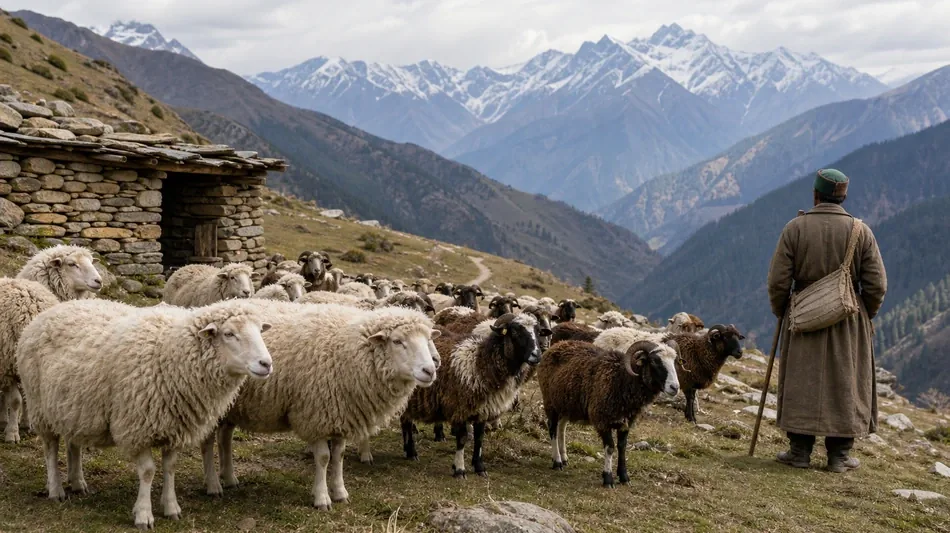
Adaptation remains uncertain. Gaddi flocks move seasonally across elevations from 200 metres to 3,400 metres and can cover 10 to 15km a day on rugged terrain. Herders said dense, soft wool could retain water during the monsoon, increasing the risk of skin infections and pneumonia, and could be damaged by thorny shrubs. They also questioned whether softer Merino-type hooves could withstand mountain routes as effectively as indigenous animals.
Pastoralists are interested in breeds that may improve income, but weak market access, limited institutional capacity and the absence of strong producer federations also depress returns from indigenous wool. Traditional Gaddi fibre is water resistant and supports products including carpets, unali coats and pattu cloth, linking the breed to local ecological knowledge and culture.
The programme’s animals will require continuous monitoring under pastoral conditions rather than only at the Nagwain farm. The report argues that Merino crossing should remain below 50%, while the quality of local Gaddi rams should also be improved so fine-wool development does not displace the indigenous breed and its associated livelihoods.
(S.Andries--TPT)