

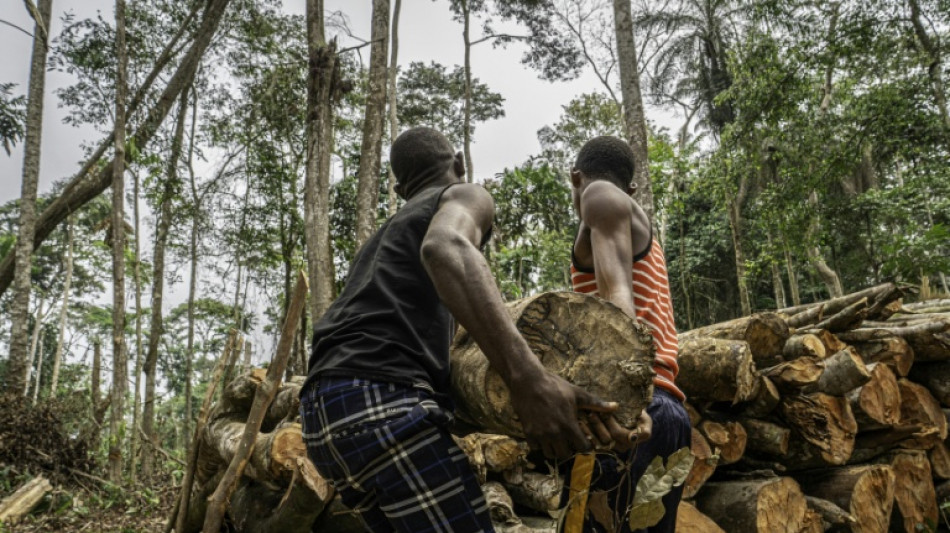
Global deforestation slowed in 2025 but surged in Congo basin: study / Photo: Glody MURHABAZI - AFP/File
Deforestation slowed worldwide last year, but the improvement is unlikely to last as the situation deteriorates in Central Africa and an exceptionally strong El Nino weather pattern intensifies, a new study said on Wednesday.
Seven million hectares of forest -- roughly the size of the Republic of Ireland -- were permanently destroyed in 2025, a 15-percent drop from the previous year, according to the annual Forest Declaration Assessment.
The slowdown, however, is not enough to keep the world from missing a pledge to end deforestation by 2030, according to the report, which was drafted by a coalition of research groups and non-governmental organisations.
The 2025 figure is "encouraging but so far it's the exception, not a new trajectory", Erin Matson, the study's co-author and lead consultant at advisory group Climate Focus, said in a media briefing.
To meet the target, agreed at the United Nations' COP26 climate talks in 2021, deforestation would have to fall by around one million hectares per year.
Clearing forests for agriculture or mining operations remains the leading drivers of deforestation.
Last year's improvement was due in part to progress in Latin America, with a 33-percent drop in what has historically been the world's deforestation "hot spot", according to the study.
The authors pointed particularly to Brazil's deforestation action plan and increased enforcement in the country's Amazon.
- 'Irreversible ' -
Progress in the region, however, "rests heavily on the choices of a small number of governments and remains highly vulnerable" to recent and upcoming elections across the Amazon basin.
Brazil's left-wing leader, Luiz Inacio Lula da Silva -- who has vowed to end illegal deforestation by 2030 -- faces populist right Senator Flavio Bolsonaro in a runoff presidential election on October 25.
Deforestation had surged under the administration of Bolsonaro's father, far-right former president Jair Bolsonaro.
Progress could also be threatened in Colombia and Peru, where hard-right presidents were recently elected, according to the experts.
Across the Atlantic in Africa, the situation deteriorated in the Congo basin, where rainforest loss reached 2.4 million hectares -- near the same level of deforestation as the Amazon for the first time.
"Losing such a size of forest every year is a disaster," said Sam Nguiffo, a lawyer and founder of the Centre for Environment and Development in Cameroon.
"As humanity, we clearly cannot afford that because it will be totally irreversible," he said.
Logging for timber or felling trees for agriculture or mining appear to prevail in forest management in Central Africa, Nguiffo said.
Deforestation has a "massive impact on the cultural identity and on the livelihood of local and indigenous communities", he said.
"The erosion of the forest, both in size and in number of species, reduces the space available for communities and fuels conflicts," the lawyer added.
- El Nino effects -
El Nino, the warming phase of a natural climate cycle, also threatens progress because its effects include droughts, creating conditions for wildfires.
The current El Nino event, which emerged in June, is expected to peak later this year but is already shaping up to be the strongest ever observed.
El Nino has been associated with strong drought in Indonesia, where tracts of forest and plantations have been burning in biodiverse Borneo and South Sumatra for months.
"If projections of the historically strong 2026-27 El Nino materialise, drought and fire risks will intensify further across tropical forest regions," the deforestation report said.
Matson, of Climate Focus, noted that there was a "huge spike" in tree cover loss during the last "super" El Nino event in 2015-2016.
"We can't fully predict the future but it's unlikely, I would say, that in 2026 we'll see the same kind of reductions (in deforestation) that we saw last year," she said.
(A.Smit--TPT)