
Lethbridge students learn how city transit and transportation systems work
Alejandra Pulido-Guzman
Alejandra Pulido-Guzman
LETHBRIDGE HERALD
The City of Lethbridge is offering education and outreach programs to connect people of all ages with the city’s essential infrastructure, helping them understand how it works and why it matters.
On Wednesday, St. Kateri Elementary School Grade 5 students had the opportunity to learn about transit and transportation through the City of Lethbridge’s education and outreach program, Ready to Ride.
Ashley Cowie, education and outreach lead for Infrastructure Services, said the goal is to help Lethbridge residents understand infrastructure services, their value and importance, and how they can actively participate in those areas.
“One of the key audiences we identified is school-age kids, because there are actually quite a few curriculum ties to these six areas of infrastructure that we support,” said Cowie. “Waste and environment, water, stormwater, wastewater, electric, transit, transportation, and planning and design.”
She explained that, to accomplish this, the city has created classroom presentations and facility tours for each of its infrastructure service areas.
“With transit and transportation, we have a program called Ready to Ride. This is where we work with kids, usually Grade 4, Grade 5 or Grade 8,” said Cowie. “But we are welcome to any classroom that might be interested.”
The program is designed to help students become comfortable with public transit and learn how to use Lethbridge’s transit system.
“Many of the skills that they gain are transferable skills. If they’re in the city of Calgary, if they’re in Paris, if they’re wherever they may be, they at least have a sense of what it means to ride public transit,” said Cowie.
Ready to Ride takes a two-part approach to teaching students about transit and transportation.
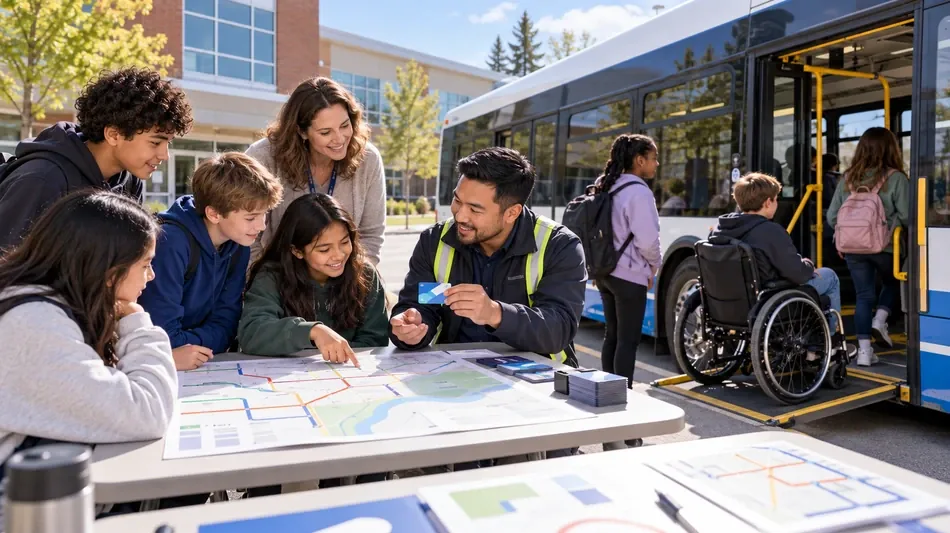
“We do a classroom portion of the presentation, which is showing them the City of Lethbridge’s tools for transit, which includes our website and our ride planner,” said Cowie.
Students choose a destination, identify their starting and ending points, and figure out how to get there with guided support.
They also learn how to pay for a ticket, obtain a transfer when changing buses and follow proper bus etiquette.
“What it means to ride and be a responsible rider of public transit,” said Cowie.
After completing the classroom portion, students have an opportunity to take a bus ride for a hands-on learning experience.
“We’ve partnered with Lethbridge Transit, where they have a bus and an operator there. The bus comes to the school, the kids get on, they give their ticket to the bus driver, just like they would, and they get a transfer,” said Cowie.
Depending on the school’s location, students are taken to a bus terminal. For St. Kateri students, the destination was the University of Lethbridge bus loop.
“At the terminal, they get off, they do a bit of a scavenger hunt, so we have the opportunity to explore that space of the terminal, but in a more playful, hands-on type of way where they’re learning about what it is they all experience there,” said Cowie.
Afterward, students board the bus again to review what they have learned and explore some of the services available to riders.
“They learn how to put a bike on the front of the bus, how to ask for their stop, they learn about accessibility and ridership responsibility around accessibility,” said Cowie. “And then they get to practise standing on the bus as riders, sitting on the bus, and they answer questions with us as we travel back to their school.”
Cowie added, to provide a realistic experience, the program also offers props that allow students to practise riding the bus while carrying items or using mobility aids such as crutches.
“We give students items like grocery bags, crutches, skateboards, and sometimes instrument cases. So they learn how to ride the bus when they have something else other than themselves going into the bus,” said Cowie.
“It’s an opportunity for them to be able to put themselves into a rider’s shoes, who maybe is limited with their mobility. But also awareness, if they’re on a bus with somebody who has crutches, or giant bags, if there’s space for them to move, what that could look like.”
(N.Davids--TPT)