
Carbon dioxide removal slow to take off, alarming scientists / Photo: Halldor KOLBEINS - AFP/File
Carbon dioxide removal experts have sounded the alarm in Milan this week over a shortfall in research and investment in the nascent sector viewed as essential for mitigating climate change.
Still marginal and costly, CO2 removal, known as CDR, consists of extracting the greenhouse gas from the atmosphere and storing it durably, whether underground or in long‑lasting products.
Massimo Tavoni, a professor of climate change economics at the Polytechnic University of Milan, told AFP that current interest in such solutions was "much less than just two or three years ago".
"When Donald Trump returned to power, things changed a lot, and then with the wars, the situation got even worse," he said.
The Milan university co-organised a conference this week with the Euro-Mediterranean Centre on Climate Change (CMCC), an Italian climate research foundation.
Currently, carbon removal efforts are only removing about 5 percent of global annual CO2 emissions, according to the third edition of the report "The State of Carbon Dioxide Removal," presented in Milan Wednesday.
The vast majority of those efforts, or 99.9 percent, are done naturally, mainly by planting trees. Through photosynthesis, the tree captures carbon from the air and stores it in its roots, trunk and branches.
From China to the United States, Europe to Brazil, reforestation makes it possible to trap more CO2, which largely comes from the combustion of coal, oil and gas.
But growth of such plantations is stagnating and hurt by competition with agricultural land, according to the report.
- No licence to pollute -
In Italy's industrial city of Milan this week, scientists from the United States, Germany, China, and Australia have been presenting results of their research on CDR.
The work is not about filtering flue gases from factory chimneys or gas- and coal-fired power plants, which is known as carbon capture and storage. Instead, the aim of carbon removal is to capture CO2 already present in the air at very low concentrations.
Scientists stressed that in the meantime, industry must not be allowed to emit even more CO2 into the air: the priority remains to reduce current emissions as much as possible and to remove the residual CO2.
Current applications call for the transformation of CO2-laden plant residues through pyrolysis -- which heats the organic matter without oxygen -- into biochar, a porous material that helps retain water and nutrients in agricultural soils, or through capturing the CO2 after burning biomass, or agricultural residues.
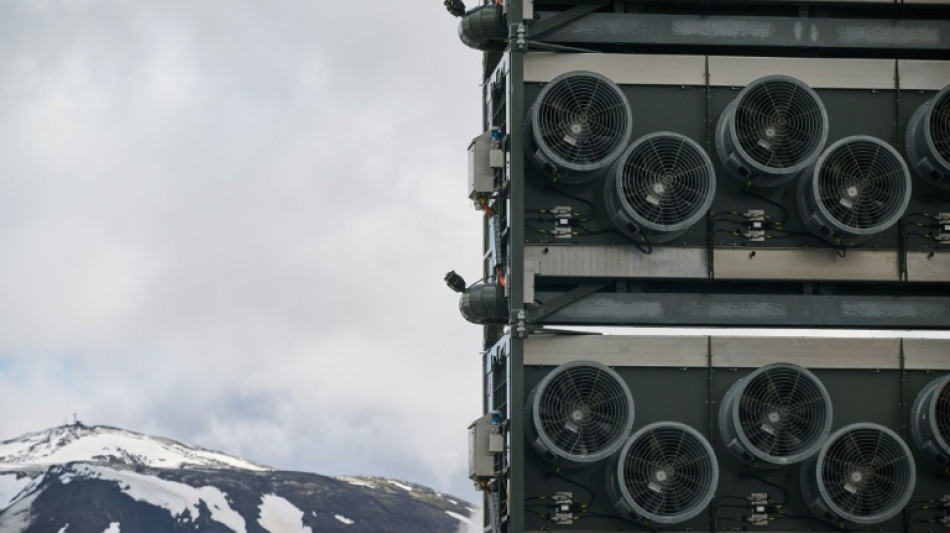
Another method known as "Direct Air Capture" (DAC) that extracts CO2 from the air using large fan-like devices is being carried out at a handful of sites around the world, most notably Iceland, but volumes remain negligible.
Meanwhile, the potential of the ocean to absorb CO2 from the atmosphere is being studied, with scientists trying to gauge whether it can safely be absorbed and recycled in some manner without further boosting the ocean's alkalinity.
Despite these efforts, in a PowerPoint presentation at the university Wednesday, the work of innovative removal methods was represented as just a tiny square compared with total emissions, or 2 million tonnes of CO2 removed last year out of more than 40 billion tonnes emitted by humans.
Cost is a major factor -- most removal methods cost more than $200 per tonne of CO2, well above current CO2 prices.
- Public good -
Required CDR investments run in the billions of euros, scientists agree.
"Scaling up these technologies takes time, and that's why the coming years will be truly crucial," said Morgan Edwards of the University of Wisconsin–Madison, who oversaw the evaluation report funded by universities, the European Commission and the United Kingdom.
So who will pay to filter the air?
Edwards argued that carbon dioxide removal was a "public good".
"We can have companies who are playing this important early role but in the long term we're going to need governments to be buying this public good," she added.
(P.Ngobeni--TPT)