
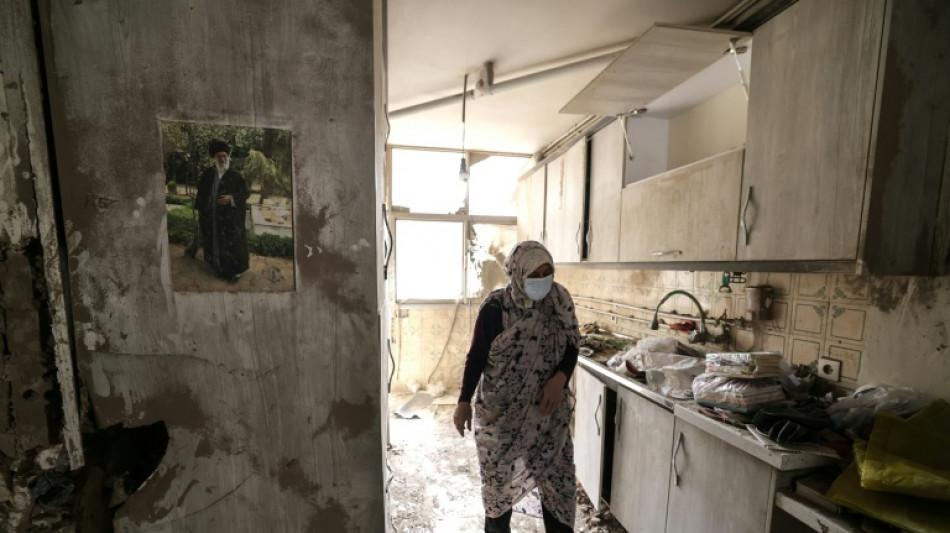
Israel strikes Tehran, Beirut as Iraq pulled deeper into Mideast war / Photo: Atta KENARE - AFP
Israel launched a wave of strikes on Tehran and Beirut on Tuesday while attacks in Baghdad drew neighbouring Iraq deeper into the Middle East war that has sparked economic turmoil across the globe.
The Iranian capital, under near-daily bombardment since a joint US-Israeli attack started the war on February 28, was hit by what the Israeli military said were strikes on "terror regime infrastructure".
The war, now in its third week, has killed hundreds and quickly spread to include Iranian strikes on Gulf nations as well Israeli bombardment of Lebanon.
Lebanese state media reported Tuesday that Israeli strikes at dawn hit a residential building in Beirut's southern suburbs, a stronghold of the pro-Iranian armed group Hezbollah.
Authorities in Lebanon said more than one million people have registered as displaced since March 2, with more than 130,000 people staying in upwards of 600 collective shelters.
The nation was drawn into the war when Tehran-backed Hezbollah militants struck Israel over the killing of Iranian supreme leader Ayatollah Ali Khamenei on the first day of the conflict.
The regional war has also steadily pulled Iraq further into the fighting, after the country has long been a proxy battleground between the United States and Iran.
A drone and rocket attack targeted the US embassy in Baghdad early Tuesday, while a strike killed four people at a house reportedly hosting Iranian advisors.
The strikes on the complex came hours after air defences thwarted a rocket attack at the embassy and a drone sparked a fire at a luxury hotel frequented by foreign diplomats in Baghdad's fortified Green Zone.
War in the Mideast has sent oil costs soaring, and prices resumed their climb on Tuesday as several countries pushed back against US President Donald Trump's demand that they help secure the Strait of Hormuz, while Iran continued to target crude-producing neighbours.
Traffic in the Gulf waterway through which a fifth of global crude oil passes has been severely disrupted by the war.
Repeated attacks on oil infrastructure -- including strikes on major fields in the United Arab Emirates and southern Iraq -- have contributed to the unrest in the markets.
Global oil prices have surged more than 40 percent since the US and Israel began their strike abd the impact has been felt globally.
Australia's central bank hiked its key interest rate Tuesday, pointing to "sharply higher fuel prices" driven by the US-Israel war on Iran.
- Armada to Hormuz -
Trump demanded allies join with "great enthusiasm" an armada to escort tankers through the strait.
"We strongly encourage the other nations to get involved with us and get involved quickly," Trump told reporters at a White House event.
Trump has warned that it would be "very bad" for the future of NATO if the allies refused to help and suggested he could delay a summit with Chinese leader Xi Jinping by a month or so over the issue.
British Prime Minister Keir Starmer said London was working with allies to craft a "viable" plan to reopen the strait, but ruled out a NATO mission.
Berlin also said it "has been clear at all times that this war is not a matter for NATO".
Japan, Australia, Poland, Spain, Greece and Sweden also distanced themselves from any military involvement in the Strait of Hormuz.
EU foreign ministers discussed the war in Brussels on Monday but showed "no appetite" for extending their Red Sea naval mission to help reopen Hormuz, the bloc's top diplomat said.
Western allies Canada, France, Germany, Italy and the United Kingdom also urged Israel to show restraint in Lebanon, where it has announced "limited ground operations" against Hezbollah.
But Israel's President Isaac Herzog told AFP that Europe should support "any effort to eradicate Hezbollah now".
- Defiant tone -
The war has now engulfed the region, with Iran striking at least 10 countries that host US forces and its Revolutionary Guards saying it had fired around 700 missiles and 3,600 drones.
More than 1,200 Iranians have been killed by US and Israeli strikes, according to the last toll from Iran's health ministry on March 8, which could not be independently verified.
But Tehran's foreign minister struck a defiant tone on Monday.
"By now they have... understood what kind of nation they are dealing with," Abbas Araghchi told reporters in Tehran.
Iran, he said, "does not hesitate to defend itself and is ready to continue the war wherever it may lead, and take it as far as necessary".
Despite the violence and more than two weeks of internet blackout, some Iranians have sought to restore a sense of normalcy, with cafes and restaurants reopening and the popular Tajrish bazaar in Tehran busy over the weekend ahead of the coming Persian new year.
There is little sign of a popular uprising within Iran, where security forces killed thousands during protests in January.
The UN refugee agency says up to 3.2 million people have been displaced in Iran.
burs-oho/jm
(M.Boreen--TPT)