
Raisin moonshine banned in Iran enjoys resurgence in New York / Photo: CHARLY TRIBALLEAU - AFP
Three Iranian men pressed rehydrated raisins at an artisan distillery just outside New York, thousands of miles from their war-struck homeland.
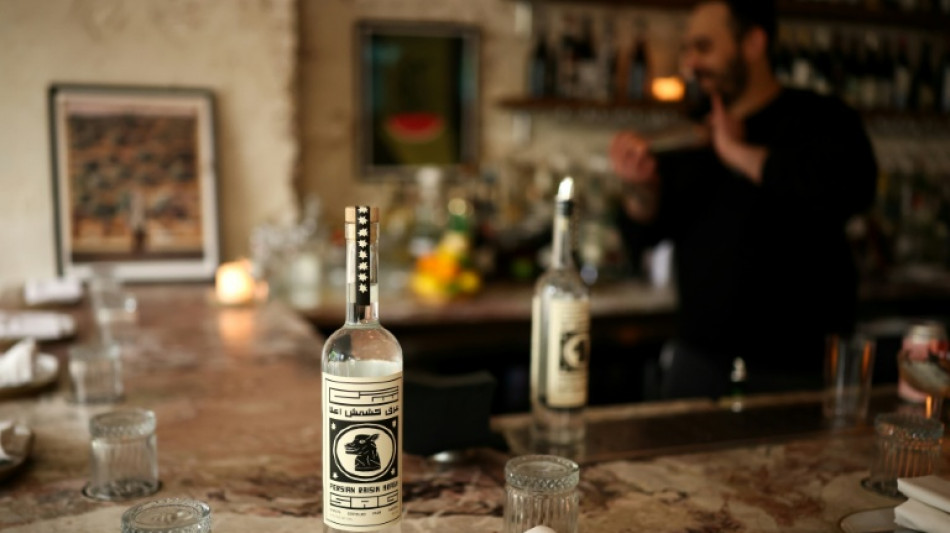
They were carefully producing aragh sagi, a traditional spirit banned by the clerical authorities along with all alcohol following the 1979 Islamic revolution.
Despite its outlaw moonshine status, the drink is still made clandestinely and consumed inside Iran.
"Everybody's drinking, but we just don't want to get caught," said Siavash Karampour, formerly a fixture on Tehran's rock music scene and now the co-manager of a bar in Brooklyn.
Together with three childhood friends who, like him, came to New York to rebuild their lives, they decided to brew the Iranian firewater in the United States.
They say they wanted to offer others like them a taste of home as well as "something that has been behind the curtain."
Branded as "SAG," their aragh sagi -- like a stronger Italian grappa -- is made in the still of David Nahmias, a distiller born into a Moroccan Jewish family who makes mahia, a traditional dried fig-based spirit from his homeland.
"They came to me through word of mouth. Their alcohol uses the same process as arak, which you find in Syria or Lebanon -- but without the anise. It wasn't complicated for me... And I liked them!" Nahmias said.
The creators of SAG, aged between 35 and 41, settled in New York several years ago and remain active in the local Iranian diaspora and all have day jobs.
They were the first to bring aragh sagi to the US market, although a handful of brands exist in Europe.
-' I feel privileged' -
The company's output of 7,000 bottles a year -- sold for $50 a pop in around 30 liquor stores and available in as many bars -- remains modest.
But bars have latched on to their creation as a way to promote new cocktails.
"We just started this back in the day, as a hobby... we kind of want to grow organically," said brew group member Sasan Oskouei, a visual artist.
The entrepreneurs see their venture as a project that goes beyond a simple spirit, representing an emotional and cultural gesture.
"So many Iranian artists and filmmakers have highlighted some parts of Iran that haven't been seen before, and in making this, we are kind of doing the same thing," said Karampour.
Since they launched SAG two years ago, many artistic projects have emerged to complement the brand, with parties in New York and DJ sets performed by Iranian musicians.
Their connection to Iran through friends and family is constant, making the ongoing conflict between Tehran and their host nation all the more painful.
"It's really tough to be seeing all these images, and then you still have to go to work and live your daily life... You technically live in two countries," said Karampour.
With the help of large handheld food mixers, they carefully grind the mixture of dried Californian grapes and water, which they then ferment before distilling it in a large still imported from Germany.
Amir Imani, a computer engineer, says New York was the ideal place to establish their brand, a city that is both very diverse and tolerant, and where their business is not written off as "exotic."
"Being in New York helps, because I can see people are not supportive of what is happening in this administration -- either the war or like Immigration and Customs Enforcement and all of that," Imani said.
"So I feel privileged that I'm here surrounded by people who think the same."
(H.VanNiekerk--TPT)