

Iran says return to war unlikely, but Trump 'not satisfied' with deal / Photo: ATTA KENARE - AFP
Iran said on Wednesday that a return to war with the United States was unlikely as the two sides inched towards a deal, though President Donald Trump said he was not happy with Tehran's latest offer.
The US leader warned he might be compelled to "finish the job" if a better arrangement was not reached, even as optimism for a peace deal that would reopen the crucial Strait of Hormuz trade route sent oil prices tumbling.
With fighting paused since an April 8 ceasefire, negotiations to bring an end to the conflict and resume trade through the blockaded waterway have stalled, leaving the global economy shaken by the tumult.
But senior Iranian Revolutionary Guards official Mohammad Akbarzadeh said the likelihood of a return to "war is low because of the enemy's weakness", but warned the military was "lying in wait with full magazines" in the event of an attack, Tasnim news agency reported.
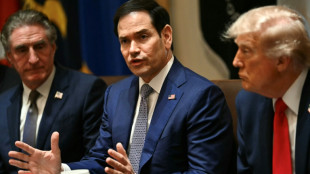
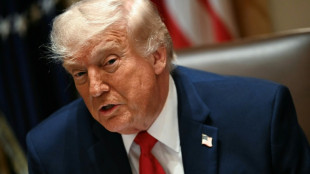
Trump, meanwhile, said in a cabinet meeting at the White House that he was in no rush to reach an accord, despite saying at the weekend that one was close.
"Iran is very much intent, they want very much to make a deal. So far they haven't gotten there. We're not satisfied with it, but we will be," he said.
"Either that or we'll have to just finish the job."
The Middle East war erupted in late February with US-Israeli strikes on Iran, engulfing the region and sending oil prices skyrocketing.
After hints of progress from both sides, hopes for an imminent deal to avoid further hostilities sent benchmark oil contracts falling more than five percent on Wednesday.
Adding to optimism was an Iranian state TV report that said Washington had committed in a draft framework to lifting its naval blockade on Iran, as well as restoring traffic in the Strait of Hormuz and withdrawing American forces from the Gulf region.
The report cited what it described as an outline of a potential memorandum of understanding, but the White House swiftly blasted it as "a complete fabrication".
A day earlier, Iran accused the US of breaching the ceasefire and warned it was prepared to retaliate following the most serious strikes since the truce took effect.
The US military said it had launched "self-defence strikes" targeting Iranian missile sites and mine-laying boats overnight Monday to Tuesday.
Tehran's intelligence ministry, meanwhile, said the US and Israel were still seeking to overthrow the Islamic republic and partition Iran, accusing them of seeking to foment division and carry out sabotage missions.
- 'Will there be missiles?' -
Iran and the US have been engaged in a war of words for weeks as they try to negotiate a deal, with mediation efforts led by Pakistan.
Neither side appears ready to compromise on the key sticking points, which include the Strait of Hormuz and Iran's nuclear programme.
On Wednesday, the Revolutionary Guards' navy insisted that only ships "willing to abide by Iranian order" would be allowed to pass through the waterway.
US Secretary of State Marco Rubio had said on Tuesday that a peace deal remained within reach, but that the Strait of Hormuz would be reopened "one way or the other".
In a further step towards normalcy for Iranians, authorities partially restored access to the global internet on Tuesday, after a three-month shutdown.
"I do feel better now because I finally can use my favourite applications," said Hana, a 20-year-old student in Tehran who gave only her first name.
"At the same time, I have this concern that war might resume any minute and just cut me off again from my friends."
Amir, a 27-year-old software developer in the Iranian capital, also said he feared renewed fighting despite the talk of a deal.
"I feel like nothing is certain yet... The daily question is, will there be missile strikes tonight?"
- Fighting expands in Lebanon -
On the Lebanon front of the war, Israel launched broad strikes on Wednesday and declared a huge swathe of the country's south a new combat zone, urging its residents to leave.
The warning called into further question a fragile ceasefire that took effect on April 17 but has done little to halt the fighting between Israel and Iran-backed Hezbollah, which dragged Lebanon into the war when it attacked Israel in early March.
Iran has demanded that any peace accord apply to Lebanon.
An Israeli military spokesman warned Lebanese civilians to evacuate north of the Zahrani River -- which runs roughly 40 kilometres (25 miles) north of the Israel-Lebanon border -- "as all areas south of the river are considered combat zones".
Hezbollah had said earlier that its fighters clashed with Israeli forces "at point-blank range" in a strategically significant town just beyond an Israeli-declared "yellow line" in south Lebanon where its troops have been operating.
The yellow line largely tracks the Litani River, about 30 kilometres south of the Zahrani.
Israeli Prime Minister Benjamin Netanyahu on Monday vowed to "crush" Hezbollah, and Israel's army chief Lieutenant Colonel Eyal Zamir said on Wednesday that "we are intensifying our operations in order to strike ever more severe blows to the Hezbollah organisation".
burs/smw/jfx
(P.Ngobeni--TPT)