
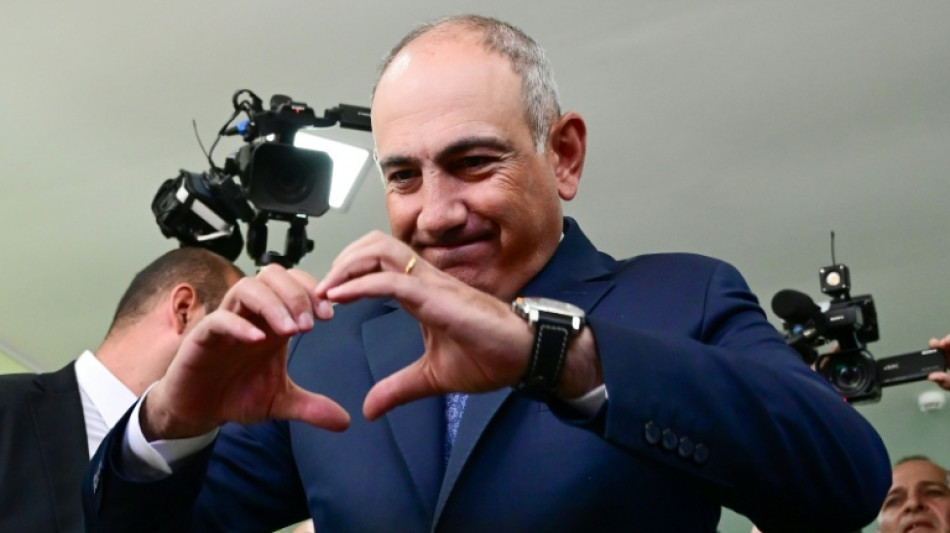
Armenia PM wins vote, cementing Westward tilt / Photo: Karen MINASYAN - AFP
Armenian Prime Minister Nikol Pashinyan's ruling party has won parliamentary elections, preliminary results showed on Monday, a victory seen as endorsement of the nation's pro-Western shift after threats from Moscow and claims of Russian interference.
Pashinyan's push to forge closer ties with the West and move Armenia out of the orbit of its former imperial ruler has angered the Kremlin and drawn rebukes from President Vladimir Putin.
The election comes after years of turmoil since Pashinyan was swept to power in a 2018 street revolution.
The small Caucasus country is still haunted by Azerbaijan's 2023 military takeover of Karabakh, which ended decades of territorial conflict and prompted the exodus of the enclave's 100,000-strong ethnic Armenian population.
Pashinyan framed the vote as a choice between lasting peace with Azerbaijan and a return to war.
His ruling Civil Contract party got 49.8 percent of the vote, comfortably ahead of the 23.3 percent of the Russian-Armenian billionaire Samvel Karapetyan's Strong Armenia alliance, the Central Election Commission said.
Pashinyan had the backing of Europe and the United States ahead of the vote.
French President Emmanuel Macron on Monday congratulated him and said the result would boost "momentum toward closer ties with Europe".
Two other opposition forces -- ex-president Robert Kocharyan's "Armenia" alliance and the Prosperous Armenia party -- also cleared the electoral threshold to get into parliament, winning 9.9 percent and four percent of the vote, respectively.
Turnout was 59 percent, the commission said.
Analyst Armen Badalyan said the result means that Pashinyan's party "won enough seats in the new parliament to form the country's next cabinet".
"But it fell short of the super majority needed to pass constitutional amendments" demanded by Azerbaijan as a condition for a final peace treaty.
- 'Prosperity and cooperation' -
Pashinyan hailed his party's "historic victory that will ensure Armenia's eternity and development".
He pledged to follow a balanced foreign policy, saying Yerevan will "continue the course of rapprochement with the West" while also deepening Russia ties.
"The Armenian people voted for regional prosperity and cooperation, and I hope this will draw a positive response from Turkey and Azerbaijan," he told a news conference, adding that "we need to institutionalise peace between Armenia and Azerbaijan".
He also vowed "the final eradication of the criminal-oligarchic system from Armenia", saying: "The leaders of these forces must be held criminally liable."
His opponent Karapetyan called the elections "shameful", denouncing alleged violations and repression and saying dozens of his campaign staff had been arrested.
Critics accuse Pashinyan of using the courts, police and administrative resources to pressure opponents, saying his reformist government has drifted toward authoritarian methods despite continued political competition.
Armenia's Investigative Committee said it had opened 59 criminal cases over alleged electoral violations -- including people casting multiple ballots -- and detained nine.
- 'Enemies of freedom' -
Karapetyan has denied claims he would pull the country back under Russian dominance, and warned against what he called Pashinyan's "reckless rush" toward the West.
He has been under house arrest since last year on charges of plotting a coup, which he rejects as politically motivated.
Pashinyan has frozen participation in a Russia-led security bloc, signed a strategic partnership agreement with Washington, and set Armenia on a path toward possible EU membership.
Moscow has reacted sharply to the prospect of losing another ally in what it sees as its sphere of influence.
In a pointed warning, Russian President Vladimir Putin said in May: "We all see what is happening with Ukraine now... How did it all begin? With Ukraine's attempt to join the EU."
The Kremlin was widely accused of seeking to sway the vote.
Analysts have noted online misinformation, hacker activity and Kremlin-friendly narratives portraying Western cooperation as dangerous.
In the weeks before the vote, Russia unleashed a trade war on Yerevan, banning the import of several products from Armenia.
Armenian officials have also warned that "enemies of freedom" are bankrolling propaganda campaigns.
For many Armenians, the opposition remains associated with Russian influence and oligarchs.
(M.Coetzee--TPT)