
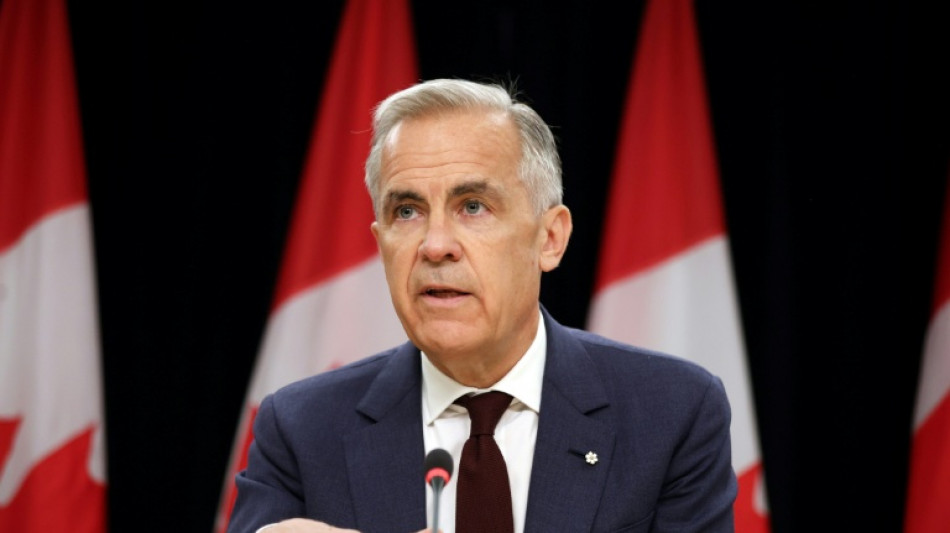
Canada chooses Germany's TKMS to build new fleet of submarines / Photo: Dave Chan - AFP
Canada has chosen Germany's Thyssenkrupp Marine Systems to build its new multi-billion-dollar fleet of submarines, Prime Minister Mark Carney said Monday, as his government works to deepen defence ties with European NATO allies.
Carney made the announcement before heading off to a NATO summit in Turkey, where members of the 32-nation alliance are looking to show US President Donald Trump they are delivering on a defence spending vow.
Canada's ageing British-built Victoria-class submarines are to be formally decommissioned within the next 10 years.
Ottawa in 2024 launched a process to procure 12 new submarines and last August named two finalists for the contract: TKMS and Hanwha Ocean Co. of South Korea.
Speaking in the Atlantic coast city of Halifax before flying to the NATO meet, Carney said TKMS had edged out the South Korean firm.
"This was a difficult, close decision between two highly qualified suppliers," Carney said, announcing that TKMS had been chosen as the "preferred supplier."
He said Ottawa would now enter into exclusive negotiations with TKMS on procuring up to 12 submarines, discussions that could last roughly 18 months.
If those talks fall through -- an outcome Carney said was unlikely -- Canada still has the right to turn back to Hanwha.
Carney declined to discuss dollar figures, citing the confidentiality of the negotiations, but said the deal will bring "tens of billions of dollars" into the Canadian economy.
- NATO factor 'ultimate decider' -
The South Korean side pushed hard for the contract, reportedly offering a series of incentives, including lucrative partnerships with Canadian firms, ranging from steelmakers to auto companies.
But Wesley Wark, a Canadian defence policy expert at the Centre for International Governance Innovation, told AFP that TKMS likely always had "the upper hand" because of Carney's desire to partner with a European NATO ally.
"I think the NATO element was ultimately the decider," Wark told AFP.
Reacting to the announcement, German Chancellor Friedrich Merz called it a "strong signal in support of transatlantic and European cooperation in the defense industry."
This week's NATO gathering comes a year after alliance members pledged to ramp up security-related spending to five percent of GDP by 2035 under pressure from Trump.
Carney has advanced historic increases in military spending since taking office last year, while warning that Canada needs to reduce its security dependence on the United States.
Enhancing ties with NATO allies in Europe has been a priority, and under Carney Canada became the first non-EU member to join the European defence procurement scheme.
Canada is implementing a "pivot" towards transatlantic and European security, Wark said, making the German bid particularly attractive.
In his announcement, Carney noted that TKMS "provides submarines to over one-third of the NATO Alliance."
But spurning South Korea will come at a cost, Wark added, noting Carney would likely have a "tough diplomatic moment" in Turkey this week, with South Korean President Lee Jae Myung expected at the NATO meet.
"It's a tough decision because for Canada, we also have Indo-Pacific commitments," Wark said.
"We're looking to South Korea as a key partner."
(G.VanRooyen--TPT)