

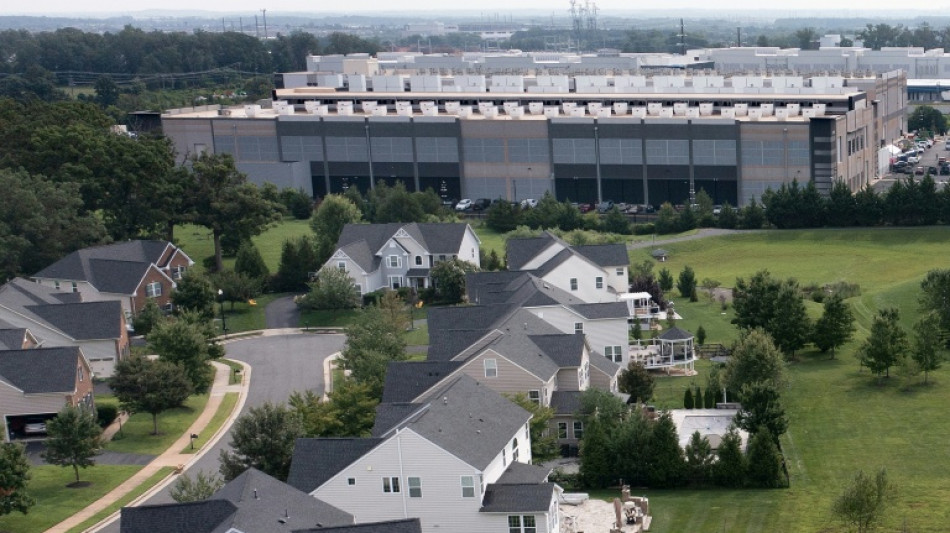
US House targets data centers as midterm backlash grows / Photo: Brendan Smialowski - AFP
The US House of Representatives is set to vote Wednesday on whether data centers should shoulder more of their own electricity costs, as the power-hungry engines of America's AI boom become a major issue in November's midterm elections.
The bipartisan Ratepayer Protection Act would require state utility regulators to consider special rules ensuring the sprawling server farms meet the expense of new power generation, transmission lines and other grid upgrades needed to serve them.
The measure targets one of the most politically potent complaints surrounding the rapid spread of the giant facilities, with ordinary Americans being left to subsidize the extraordinary electricity demands of artificial intelligence.
On one grid covering 67 million customers -- including in perennial swing state Pennsylvania and hotly contested Senate battleground Ohio -- increased data center demand helped drive costs up by $9.3 billion in a single year -- a 174 percent rise, according to an independent market monitor.
But electricity bills are only part of a backlash that has spread across the country, fueled by concerns over water consumption, pollution, noise and lucrative tax breaks offered to wealthy technology companies.
In Brazoria, Texas, resident Melissa Burnett told AFP last month that a 17-megawatt facility near her home sounded "like a freight train always coming at you."
"We were not supposed to hear it, nor was it supposed to affect our quality of life, and it's just done the opposite," she said.
Candidates in more than 20 races across at least 18 states have run television advertisements mentioning data centers this election cycle, almost evenly divided between Republicans and Democrats.
- Wider AI fears -
President Donald Trump remains an enthusiastic supporter of rapid data center construction, arguing that the United States must expand AI infrastructure to defeat China in the global technology race.
His administration persuaded Google, Microsoft, Meta, Oracle, xAI, OpenAI and Amazon to sign a voluntary pledge not to leave consumers paying for new power infrastructure.
But opposition has spread among candidates in both parties despite the White House's stance.
Texas Republican Governor Greg Abbott -- who is up for reelection in November -- has frozen new projects while officials study their effects on electricity and water supplies, while New York has imposed a year-long moratorium on new hyperscale centers.
In Ohio, Republican Senator Jon Husted has been battered by Democratic opponent Sherrod Brown over his previous support for data centers and is urging the upper chamber to move quickly on the House ratepayer bill if it passes.
Public anxiety has intensified following warnings from researchers and industry leaders about increasingly powerful systems, while lawmakers remain deeply divided over how aggressively Washington should intervene.
Nearly two-thirds of Americans in a new Politico poll said AI could eventually pose a threat to humanity, while 48 percent favored pausing development of more advanced models.
Louisiana Republican Senator John Kennedy is seeking passage of legislation requiring AI companies to maintain a "kill switch" allowing them to shut down dangerous systems.
And Republican Senator John Curtis of Utah has joined Democratic Senator Lisa Blunt Rochester of Delaware in calling for urgent public hearings bringing lawmakers and AI developers together to consider regulation.
"Americans deserve representation in Congress that is not only well-informed on cutting-edge AI development, but also has the wherewithal to cross the aisle," they said in a joint statement.
(M.Boreen--TPT)