
Pennsylvania Democrats secure state trifecta in midterm elections
From Congressional races to a new reality in Pennsylvania, Tuesday night’s Midterm Elections gave Republicans the blues. The soundtrack for Tuesday night’s midterm elections depend on which side of the political fence you were sitting on.
From Congressional races to a new reality in Pennsylvania, Tuesday night’s Midterm Elections gave Republicans the blues. The soundtrack for Tuesday night’s midterm elections depend on which side of the political fence you were sitting on.
For Democrats, who rode a wave of discontent of the Trump administration due to tariffs, expensive gas and food prices, and the military conflict in Iran that has exacerbated both, the air was abuzz with a celebratory chorus of techno-music, hip-hop and thumping R&B. But for the Republicans who were drowned in that wave of discontent, it was a never-ending night of the blues.
During the day, local Democrats were optimistic about, well, everything. While hosting the Laborer’s biannual Election Day luncheon at the South Restaurant and Jazz Club, Ryan Boyer, president of the Philadelphia Building and Construction Trades Council, spoke a little about turnout. While it was slightly lower in Philadelphia than it was for the 2018 midterms — 40% of Philadelphia’s registered voters made their voices heard on Tuesday — there was a buzz in the suburbs, he stated.
“The turnout in the collar counties where there’s competitive State Senate races or congressional races is really good,” he stated, “Philadelphia is a little boring, sleepy, but I think that in Pennsylvania, you’re going to see the Democrats probably get a tie in the Senate, and we’re going to expand the majority in the in the state house. You’ll probably see a lot of Democrats elected to Congress.” That turned out to be an understatement.
Four new Pennsylvania Democrats is expected to be among the 255 members of the new majority in the House of Representatives when the new Congress is seated in January. Eleven of Pennsylvania’s 17 Congressional seats is expected to be occupied by Democrats. Some of those seats were no surprise as incumbents Brendan Boyle, Mary Gay Scanlon, Madeleine Dean, Chrissy Houlihan, Summer Lee and Chris Delusio retained their seats.
It wasn’t even a surprise that State Rep. Chris Rabb won his race against Dennis Mahoney to replace Congressman Dwight Evans, who is stepping down in January. But what was a surprise was that four Congressional seats were flipped from red to blue, including one that had been occupied by members of the same family for over a decade.
Bucks County Congressman Brian Fitzpatrick, a five-term Congressman that was considered one of the more moderate and independent voices among Republicans in Congress, lost his bid for a sixth term to Bob Harvie, a Bucks County Commissioner. Harvie is expected to be the first Democrat to hold the seat since 2011. Some not-so-independent Republicans as well fell to defeat on Tuesday. Former TV anchor Janelle Stelson defeated Scott Perry, the former leader of Congress’s far-right Freedom Caucus. The two went head-to-head in 2024 and Perry won by one percentage point.
Scranton Mayor Paige Cognetti defeated Rob Bresnahan, who had won the seat by two percentage points in 2024. Just as the Trump wave swept him in, the blue wave swept him out. Bob Brooks, whose campaign commercials played on his time as a firefighter in Bethlehem, Pennsylvania and a union organizer, defeated Ryan Mackenzie to win a seat that had flipped from blue to red in 2024.
This is good news for Pennsylvania in general and Philadelphia in particular, Boyer stated. Because there is expected to be members of the delegation in leadership positions, resources that might not have been available in the past may be accessible now, he stated. “Congressman Brendan Boyle becomes the chairman of the Budget Committee, so it means billions of dollars flowing into Philadelphia,” he stated. “It means that we finally get our allocation of highway funding, school funding. [The City] becomes a player in every negotiation, even if it has to be bipartisan negotiation. Because if Brendan Boyle doesn’t sign it, it’s not going to happen.”
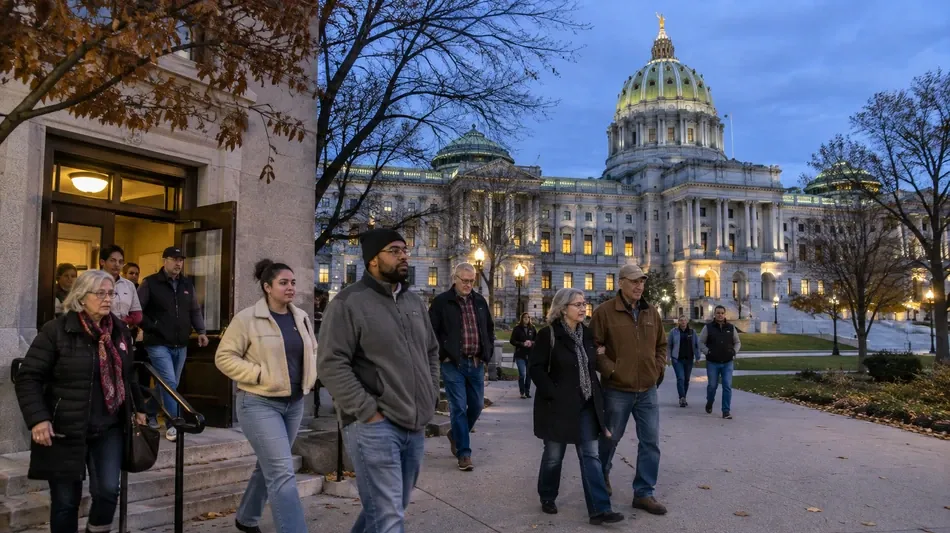
Meanwhile on the local scene, a term commonly used in horse racing — the trifecta — became the word of the day for Pennsylvania’s legislators. For the first time since 1993, the Democrats have control of the Governor’s mansion, the House and the Senate.
No one expected Shapiro, who is seen as a possible contender for the 2028 Democratic Presidential nomination, to have any trouble retaining his seat. In fact, the race between Shapiro and his Republican challenger Stacy Garrity was called in Shapiro’s favor shortly after the polls closed. Speaker of the House Joanna McClinton will have a larger margin to work with as Democrats increased their majority from three seats to 23 seats in the House, with some seats still being decided.
Over the last four years, the state House has passed legislation for such things as raising the minimum wage, only to see it die in the Senate. While there have been efforts to change the makeup of the Senate, those in the political know felt that was at least six years away from happening. Christmas came early this year as four Republican Senate seats — Frank Farry in the 6th District, Jarrett Coleman in the 16th District, Tracy Pennycuick in the 24th District and Rosemary Brown in the 40th District — were flipped to become Democratic seats. Eileen Hartnett Albillar, Mark Pinsley, Chris Thomas and Brian Wrightson will become part of the Democrats’ 26-24 majority in the Senate in January.
Having a trifecta could move to finally enable some things that Philadelphia — which has recently regained the title of the poorest large city in America — really needs, stated State Sen. Vincent Hughes, who is expected to be majority appropriations chair in the new Senate. “You change the economic outlook and the economic situation for Philadelphians and all Pennsylvanians by raising the minimum wage,” he stated. “You double the income of regular folks who are working on a daily basis and getting paid $7.25 an hour. In the proposal that the House has sent over to the Senate Republicans for years, you double it to $15 an hour with a cost-of-living adjustment, and that has a huge economic impact. Because remember this: a minimum wage worker is not spending their money on their offshore investments. A minimum wage worker is spending that money locally.”
The new legislatures will begin their service in January.
(N.Davids--TPT)