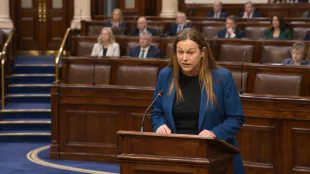


Texas Gov.-elect Hinojosa Plans Rate Freeze Amid Legal Concerns
Texas Governor-elect Gina Hinojosa has announced plans to declare a high-cost emergency and freeze residential electricity rates on her first day in office. The proposal has drawn immediate skepticism from energy policy experts who warn it may conflict with the state’s competitive market structure and invite swift legal challenges from utility providers.
Texas Governor-elect Gina Hinojosa has outlined a plan to declare a high-cost emergency and freeze residential electricity rates on her first day in office, a move that has prompted immediate warnings from energy policy experts regarding its legality and impact on the state’s power grid.
Hinojosa, who is scheduled to be sworn in on January 19, 2027, stated in an interview with the Texas Tribune that she intends to issue an emergency executive order within an hour of taking the oath of office. The initiative is framed as a response to what she described as an affordability crisis for residents.
"Within an hour of taking the oath of office, I will declare a high-cost emergency in the state of Texas and issue an emergency executive order to … freeze electricity rates," Hinojosa said. In a separate interview with a local energy data group, she added, "On Day One as governor, I’ll freeze residential electricity rates and make corporations finally pay their fair share."
The proposal has raised concerns among industry observers that the freeze could clash with Texas’s uniquely competitive energy sector. The state’s grid operates on an energy-only wholesale market where generators are paid primarily for the electricity they produce rather than for standing capacity. Critics argue that preventing suppliers from adjusting prices to reflect fluctuating supply costs could inadvertently lead to energy shortages.
Nick Loris, president of C3 Solutions, a conservative coalition focused on energy and environmental policy, expressed skepticism about the legal basis for such an order. He noted that while the Texas Disaster Act allows governors to declare disasters and suspend regulatory statutes, there is significant doubt among courts and policymakers that an affordability issue qualifies as a disaster warranting such broad powers.
"I think there is a high degree of skepticism, both from courts but also from state policymakers, that this warrants such a claim — and that it is such a disaster," Loris told Fox News Digital. He predicted that the emergency declaration would face immediate legal challenges from affected energy providers.
Loris emphasized that Texas has fostered one of the most competitive energy environments in the country since passing Senate Bill 7 in 1999. The legislation opened most of the state to retail choice, allowing customers to select from over 100 retail electric providers (REPs). The law explicitly stated that electricity production and sale are not monopolies warranting rate regulation, asserting instead that prices should be determined by customer choices and competition.
According to Loris, this competitive framework provides consumers with significant flexibility, comparing the market to shopping for cereal in a grocery store where various contracts and fuel sources are available. However, he warned that a price freeze undermines this system by forcing providers to shoulder the burden of fluctuating costs without the ability to pass them on.
"If the electricity suppliers are not covering the costs that they incur, that’s going to leave them worse off and make it more vulnerable for them to adequately provide that power," Loris said. He described price signals as functioning like traffic lights, indicating when the market should speed up, slow down, or stop.
Hinojosa’s office did not immediately respond to requests for comment regarding how her administration would address potential energy shortages resulting from the rate freeze.
The governor-elect’s plan highlights the tension between political promises to lower consumer costs and the operational realities of a deregulated energy market. As Hinojosa prepares to take office, the energy sector awaits clarification on how such an executive order would be implemented within the existing legal framework governing Texas power generation and distribution.
(M.Adams--TPT)