
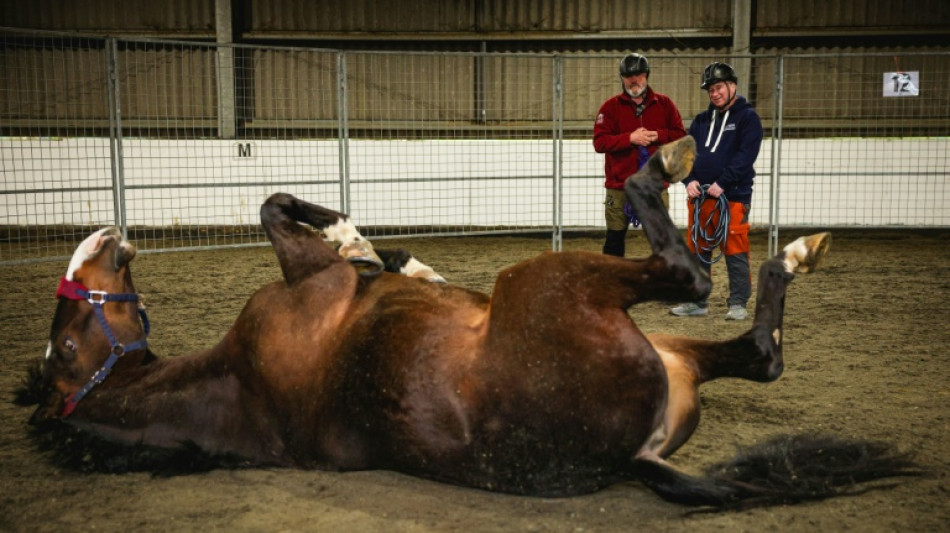
Horses unlikely saviours for those who serve in uniform / Photo: ADRIAN DENNIS - AFP
Members of the armed forces and the police may put their lives on the line for their country but even they have their mental and physical limits and often it is horses, not humans, who can provide salvation.
Former Royal Air Force reservist John Lewis contemplated suicide, serving police officer Nick Morton had a mental health breakdown and ex- military intelligence operative Al Strudwick lost his self-confidence after having both his legs amputated because of sepsis.
All three shared a fear of horses, but it was to be the animals and not the therapists who would bring the trio back from the depths of despair after being put in touch with British charity Warrior Equine.
Such has been Warrior Equine's success that it has been selected as the charity for the prestigious Royal Windsor Horse Show, which takes place on May 14-17.
Morton had over 20 years of experience, but the accumulation of dealing with traumatic incidents, such as child murders, took its toll.
"We are sometimes seen as that knight in shining armour, unflappable," he told AFP.
"But actually we're human beings. Same as our military colleagues are, we're all humans.
"We weren't born police officers or soldiers," added Morton.
- 'Overwhelmingly controlling' -
To keep costs at a minimum Warrior Equine, which was founded in 2019, has no permanent facilities or horses and uses both civilian equestrian centres and military horses for their three-day courses, of which between six and eight are held annually.
Warrior Equine was the brainchild of Ele Milwright, though she and equine instructor Jim Goddard had been working with veterans for several years before that.
As the wife of an RAF officer, Milwright had an inkling of how troubled some service personnel were after tours of duty.
"I did notice a lot of our friends and colleagues were coming back a little bit quirky," she said.
"You couldn't quite put your finger on it, but they came back and it was different.
"Nobody told you what to do about it. It was the elephant in the room.
"So three things, understanding the value of horses, understanding how horses think, their psychology, and my commitment to help people with a military background or those who serve, all came together."
The work involves the attendee leading the horse into a pen and using body language and energy to encourage the horse to move and interact.
As the attendees practise emotional self-regulation techniques, such as softening their body language, slowing their breathing and lowering their heart rate, they will aim to achieve a calm but focused state, which the horse will find safe to be around.
Lewis said the experience rescued him from the darkest of places.
The father of two had contemplated suicide after he suffered multiple fractures and spent months in hospital when a school bus squashed him between it and his vehicle.
"That vulnerability became exacerbated every time I was away from my family and my kids," he said.
"It became so overwhelmingly controlling. Even if I went into a supermarket to buy a loaf of bread and there wasn't any bread on the shelf, that was me failing to be able to protect them.
"Then I would get into conflict in the supermarket just because there wasn't bread on the shelf."
- 'Quite comical' -
Lewis had tried several types of therapy and was so sceptical about Warrior Equine he turned back three times on his way to attend a course.
However, he eventually realised "I had to give this a go because ultimately, I was going to leave my kids with no dad."
It proved to be a cathartic moment.
"The point where the horse can detect that you're in control of those stress emotions going on inside you, they will, of their own free will, walk over to you and follow you around with no lead," said Lewis.
"They'll sit on your shoulder in this amazing way. And the way it's been described to us, and you can really see it, is that they just want to sit there and trust you."
Lewis says it has transformed his life and rid him of the excessive controlling behaviour.
"That dark tunnel doesn't even stare me in the face," he said.
"I know it's there. But I'm able to turn my back on it every single time."
Such has been the positive impact on Strudwick's self-confidence he climbed the Pen y Fan mountain in Wales -- part of the test for candidates for the British SAS special forces -- in a wheelchair.
"It made me realise how far I had come, from lying in a hospital bed for 50 nights, and being released with shot-away kidneys and a slowly recovering liver, to climbing a mountain," he said.
Despite the double amputation, Strudwick is blessed with self-deprecatory humour -- his forthcoming book is titled "Finding My Feet Again" -- as is his wife.
Shedding his prosthetic legs on a crowded beach in Cornwall, he went swimming with her.
"My little stumps kept sticking out of the water, which was quite comical," he said.
"My wife joked when we were about to get out of the water that I should crawl up the beach screaming 'shark!' and see people's reaction to it."
He resisted.
"It would have traumatised the youngsters!"
(O.Mofokeng--TPT)