
Rangers Face Roster Conundrum as Injuries Mount Despite Dorofeyev's Return
The New York Rangers are confronting a significant roster challenge as injuries to key top-six forwards Gabe Perreault and Oliver Bjorkstrand threaten their lineup stability. While Pavel Dorofeyev prepares to return from injury, the team’s recent defensive lapses and ongoing personnel constraints have forced head coach Mike Sullivan to frequently adjust line combinations.
CHICAGO — The New York Rangers are navigating a complex roster situation as injuries to two top-six forwards threaten their offensive structure, even as another key player prepares to return.
Just as Pavel Dorofeyev took steps toward rejoining the lineup after missing four games with a lower-body injury, the team confirmed that Gabe Perreault and Oliver Bjorkstrand will be sidelined for extended periods. Perreault is expected to miss four to six weeks, while Bjorkstrand could be out for two to three months.
The Blueshirts have dealt with injuries throughout the season, but the simultaneous absence of these recurring top-six skaters creates a potential conundrum for constructing the team’s top two lines. Head coach Mike Sullivan acknowledged the difficulty of the situation following the Rangers’ 2-1 loss to the Chicago Blackhawks on Friday night at the United Center.
"We’re going to take the guys that we have healthy that are available to us," Sullivan said. "We’re going to try to put line combinations, defense pairs, power-play units, penalty-kill tandems together that we think give us the best chance to win."
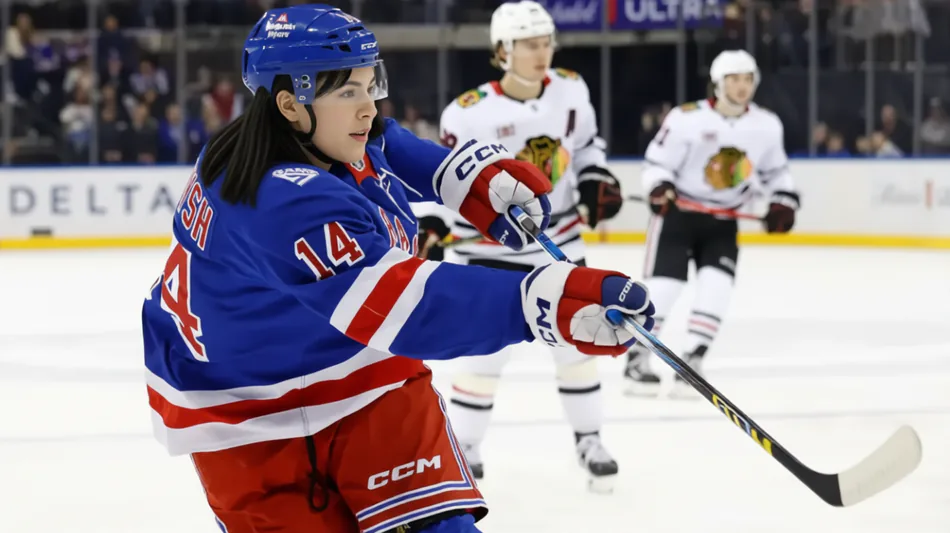
The coaching staff has already made significant adjustments. Sullivan placed usual third-liner Will Cuylle on the left wing of the top line alongside Mika Zibanejad and Alexis Lafrenière. However, for the game against Chicago, he opted for Taylor Raddysh in that spot instead. Raddysh, who began the season in the American Hockey League, has been thrust into a prominent role due to the team’s precarious situation.
Zibanejad has remained a constant presence on the first line, while Lafrenière has skated in all but three games next to him. The trio has also experimented with different configurations, including playing Lafrenière and Perreault alongside Dorofeyev for three contests.
The lineup changes come as the top unit struggles to generate sustained offensive pressure. Lafrenière noted after practice on Thursday that the team lacks sufficient time in the opposing zone. "Off the rush, we’re still getting some chances, but zone time I feel like is not there that much," Lafrenière said. "That’s what we got to work on. Trying to spend more time in their end and trying to make plays from there."
The line had shown signs of offensive stagnation with Perreault, but defensive metrics have also raised concerns. According to Natural Stat Trick, over the five games prior to the loss to Chicago, Zibanejad and Lafrenière were on the ice for the most high-danger chances against during 5-on-5 play among Rangers players.
Sullivan has emphasized that speed is the ideal complementary skill for Zibanejad and Lafrenière, as it helps them apply forecheck pressure, disrupt breakouts, and create turnovers. While the unit threatens effectively off the rush, Sullivan has called for improvement in their "down-low game" to generate more zone time.
Lafrenière agreed that maintaining puck possession low in the zone is critical. "Moving around the zone, using the D’s, and then that’s when things open up and you can make your plays," he said. "So trying to hold on to pucks low and make some plays. I think that’s what we’ve been lacking a little bit lately."
With Igor Shesterkin officially designated to season-ending long-term injured reserve, Rangers president and general manager Chris Drury has gained additional cap space. This flexibility provides Drury with options to address the roster through trades, the waiver wire, or by signing one of the remaining free agents.
The team’s recent struggles include a third consecutive loss against the Blackhawks, highlighting the urgency of stabilizing the lineup. Sullivan’s challenge is to integrate available healthy players into effective combinations while managing the defensive vulnerabilities exposed by the current top-six configuration.
(D.Khanyile--TPT)